
By Rod Gordon, Co-Founder & Coach
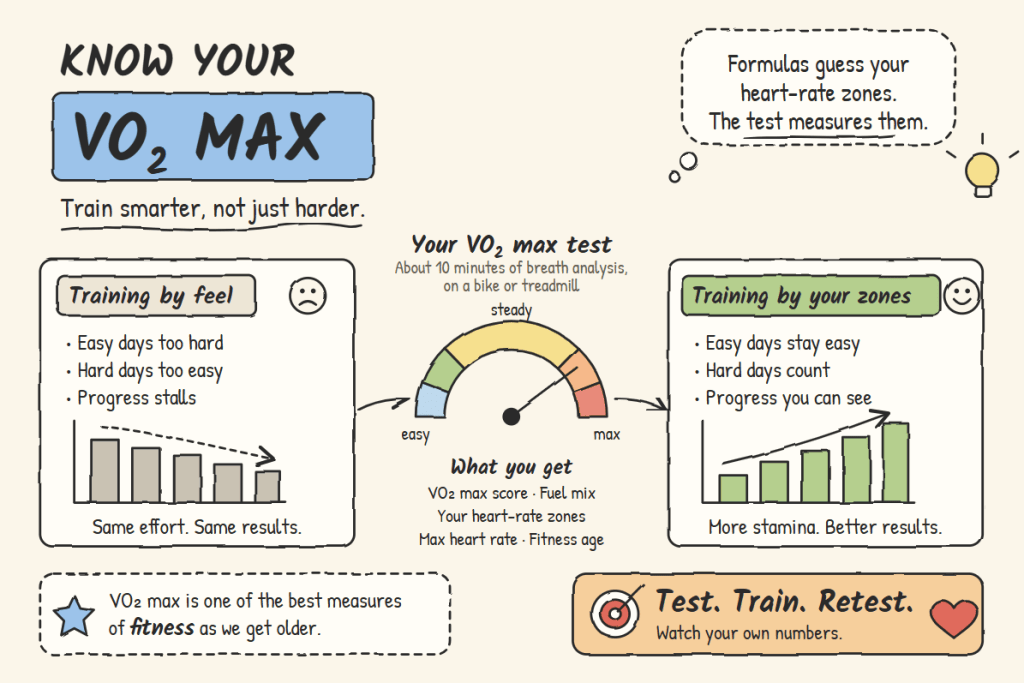
VO₂ max is the most oxygen your body can use during hard exercise. A VO₂ max test measures it directly, by analyzing your breath while you work steadily harder for about 10 minutes. It’s one of the best measures of fitness as we get older, and it turns “I think I’m in decent shape” into a number you can train against.
Whether the test is worth it depends on what you’ll do with that number. Here’s what it measures, what the test is like, what you walk away with, and who it’s right for (and who should wait).
What VO₂ max measures
Every movement you make runs on oxygen. Your lungs take it in, your heart and blood vessels deliver it, and your muscles use it to make energy.
VO₂ max is the ceiling on that whole system: the most oxygen you can take in and use in a minute, measured in milliliters per kilogram of body weight. A higher number means your body can do more work before it runs out of steam.
Climbing stairs, carrying groceries, keeping up on a hike, finishing a hard workout: they all draw on the same system.
Why it matters more as we get older
VO₂ max drops with age, and the drop speeds up in later decades. A long-term study of healthy adults found aerobic capacity declined slowly in the 20s and 30s and much faster after 70 (Fleg and colleagues, Circulation, 2005). The good news: training raises it at any age.
It’s also linked with how long people live. In a study of more than 120,000 adults who did treadmill testing at the Cleveland Clinic, people with higher fitness had lower long-term mortality, and the fittest group did best of all (Mandsager and colleagues, JAMA Network Open, 2018).
That’s an association, not a promise. But it’s one of the reasons doctors and coaches pay close attention to this number.
What the test is like at SynergyFx
We use PNOĒ, a breath analysis system. You wear a mask that measures every breath while you exercise on a bike or a treadmill, whichever you prefer. The effort starts easy and gets steadily harder. Most tests take about 9 to 12 minutes.
The last minute or two is hard, on purpose: the test is finding your top gear. Your coach is beside you the whole time, and you can stop whenever you need to.
Then you sit down together and go over your results.
What you walk away with
- Your VO₂ max score, and where it puts you for your age
- Heart-rate training zones built from your own body, not a formula
- Your ventilatory thresholds, the points where your breathing shifts as effort climbs
- Your maximum heart rate, measured instead of guessed
- Your fuel mix: how much fat versus carbohydrate you burn at different intensities
- Your biological, or fitness, age
The heart-rate zones are where most people get the most value. It’s common to go too hard on easy days and not hard enough on hard days. Your zones fix that, so every workout does the job it’s meant to do.
How to prepare
- No hard exercise for 24 hours before
- Don’t eat for 4 to 6 hours before (water is fine)
- No coffee or other stimulants that day
- Take your usual medications
- Wear workout clothes and shoes
- Arrive 15 minutes early
- Download the PNOĒ Precision app before you come
Is it worth it?
It’s worth it if:
- You exercise regularly and want to know your effort is working
- You want heart-rate zones that fit your body
- You like seeing progress in numbers, and you’ll retest
- You want a clear baseline for staying strong as you get older
It can wait if:
- You’re just getting back into exercise. Start training first, and the test will mean more in a few months. You don’t need to test to start with us.
- You won’t use the results. A number that sits in a drawer isn’t worth the money.
How often to retest
Your VO₂ max changes with training, so the test is most useful as a before-and-after. About every three months works well for most people. Our Long Game program builds it in at the start, the midpoint and the end of six months.
Pair it with an RMR test
VO₂ max shows how your body performs under effort. An RMR test shows how many calories it burns at rest. Together, they give you the full picture of your metabolism, and your nutrition plan can be built on both. We explain RMR testing in our earlier article, RMR Testing: Why It Changes How You Approach Fat Loss.
Book your VO₂ max test
A VO₂ max test is $200, or $300 together with an RMR test. Your coach goes over every number with you, and your training plan is built from them.